


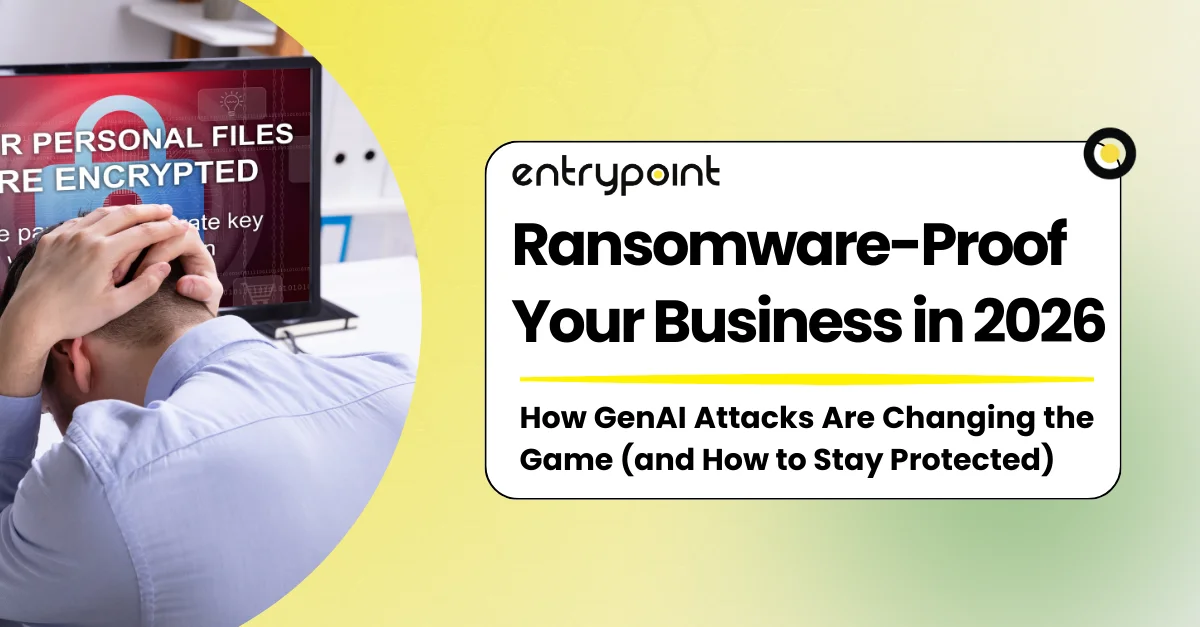
The 3 AM Phone Call Every Business Owner Dreads
It’s 3:15 AM. Your phone vibrates on the nightstand. It’s your Head of IT, and their voice is shaking. "Everything is locked. The servers, the cloud backups, even the VOIP phones. There’s a note on every screen. They want $500,000 in Bitcoin by Friday, or they start leaking employee SSNs."
This isn't a scene from a movie; it’s a reality for a growing number of mid-sized U.S. businesses. In 2026, ransomware isn't just a "virus", it’s a highly coordinated, AI-driven corporate execution.
Ransomware volume and sophistication continue to climb year over year. Attackers are no longer "spraying and praying." They use Generative AI (GenAI) to craft hyper-personalized attacks that bypass traditional security and fool even cautious employees.
The stakes are high. The Verizon Data Breach Investigations Report consistently finds that the human element plays a major role in breaches, and ransomware remains one of the costliest incident types. A prevention-first security strategy blocks most attacks before encryption begins. You don't need a 50-person security team; you need the right framework.
Understanding the New Wave: How AI-Powered Ransomware Works
To beat a modern attacker, you have to understand their new toolkit. Gone are the days of "Nigerian Prince" emails with broken English.
The Evolution of the Threat
- 2020–2022: Generic phishing. Bad grammar, suspicious links, easy to spot.
- 2023–2025: The Rise of LLMs. Attackers began using GenAI to scrape LinkedIn and company websites.
- 2026: Autonomous Campaigns. GenAI creates unique malware variants per target, references real company projects, mimics executive writing style, and can pair phishing with deepfake audio for wire-transfer fraud.
Why Traditional Antivirus is Dead
Legacy tools are "signature-based", they look for a known "fingerprint" of a virus. But GenAI creates new fingerprints every second. If your security is waiting to "detect" a known threat, you’ve already lost. Prevention-first platforms focus on behavioral intent. It doesn't matter if the file is "new"; if it starts acting like a ransomware strain, the system kills it instantly.
The Human Factor: The Verizon DBIR reports that the human element is involved in a large share of breaches. Attackers don't always "hack" in; they "log" in using credentials stolen via an AI-crafted email that looked legitimate to a stressed employee.
10 Indicators Your Business Is Being Targeted (Before Ransomware Hits)
Ransomware is the end of an attack. Here are the "smoke" signals to watch for before the fire:
| Indicator | What to Look For | Immediate Action |
|---|---|---|
| Unusual Email Patterns | Staff getting password reset emails they didn't ask for. | Reset MFA tokens immediately. |
| Failed Login Spikes | Multiple failed attempts from foreign IPs or even local US IPs. | Lock accounts and trigger a credential audit. |
| System Sluggishness | Network lag as attackers scan for your backups. | Check for unauthorized internal scanning. |
| Outbound Data Spikes | Large amounts of data leaving the network at 2 AM. | Kill the connection; data exfiltration is happening. |
| Disabled Security | EDR or Antivirus "mysteriously" turning off on one PC. | Isolate that device from the network now. |
| Unknown User Accounts | "Admin2" or "TempAccount" appearing in Active Directory. | Delete the account and audit who created it. |
| MFA Fatigue | Employees getting 20+ push notifications to their phones. | Re-train staff: "Never 'Accept' if you didn't 'Request'." |
| File Renaming | Files suddenly having extensions like .locked or .crypted. | Emergency Protocol: Shut down the file server. |
| Vendor Impersonation | Emails from "trusted" partners with "new" bank details. | Call the vendor via a known number to verify. |
| Dark Web Leaks | Company emails appearing in recent data dump lists. | Force a company-wide password reset. |
Building Your Prevention-First Defense Strategy
For a mid-market business, you need enterprise-grade protection without enterprise-grade complexity.
When to Call the Experts
If your IT person is also your "help desk guy," your "cloud guy," and your "onboarding guy," they don't have the 5,000+ hours of threat intelligence needed to fight GenAI. Professional help is critical if:
- You handle HIPAA-regulated healthcare data.
- You manage PCI-DSS or financial records subject to strict compliance deadlines.
- You have no dedicated 24/7 security monitoring.
The Value of Certified Partners (CCSE)
A Check Point Certified Security Expert (CCSE) doesn't just install software. They architect a "Prevention-First" stack:
- Email Security: AI that "reads" emails to detect GenAI manipulation.
- Endpoint Protection (EDR): Securing laptops in the office and at remote sites.
- Immutable Backups: Backups that cannot be deleted or encrypted, even by an admin account.
7 Steps to Ransomware-Proof Your Business Today
- MFA Everywhere: No exceptions. If it doesn't have Multi-Factor, it shouldn't be on your network.
- The 3-2-1-1 Backup Rule: 3 copies, 2 media types, 1 offsite, and 1 immutable (un-changeable).
- DMARC/SPF/DKIM: Properly configure your email domain so attackers can't "spoof" your CEO's address.
- AI-Powered EDR: Upgrade from "Antivirus" to "Endpoint Detection and Response."
- Segment Your Network: Don't let a breach in the breakroom reach the accounting server.
- Quarterly Phishing Sims: Use GenAI-style templates to train your staff. If they can't spot the fake, they aren't ready for the real thing.
- Incident Response Plan: Know who you’re calling before the screen goes red.
Frequently Asked Questions
- Q: Should we pay the ransom?
- A: Law enforcement and insurers generally advise against it. Many victims who pay still lose data or get attacked again, which marks you as a willing payer on criminal forums.
- Q: Does our cyber insurance cover this?
- A: Insurance may cover cleanup costs, but it won't restore reputation or lost customers. Many carriers now require MFA, EDR, and backup controls before approving claims.
- Q: Why target a small or mid-size business?
- A: Attackers automate campaigns at scale. Smaller organizations often have weaker defenses, making them profitable targets despite lower individual payouts.
Don't Wait for the 3 AM Phone Call
Every hour you operate with fragmented security is an hour a GenAI bot can probe your perimeter. "Good enough" security is an invitation for disaster.
Schedule Your Free Ransomware Risk Assessment.
Our CCSE-certified team will evaluate your current defenses and provide a Risk Report identifying your three biggest vulnerabilities.
Ready to protect your business? Contact entrypoint for a free assessment or explore our enterprise cybersecurity solutions.